


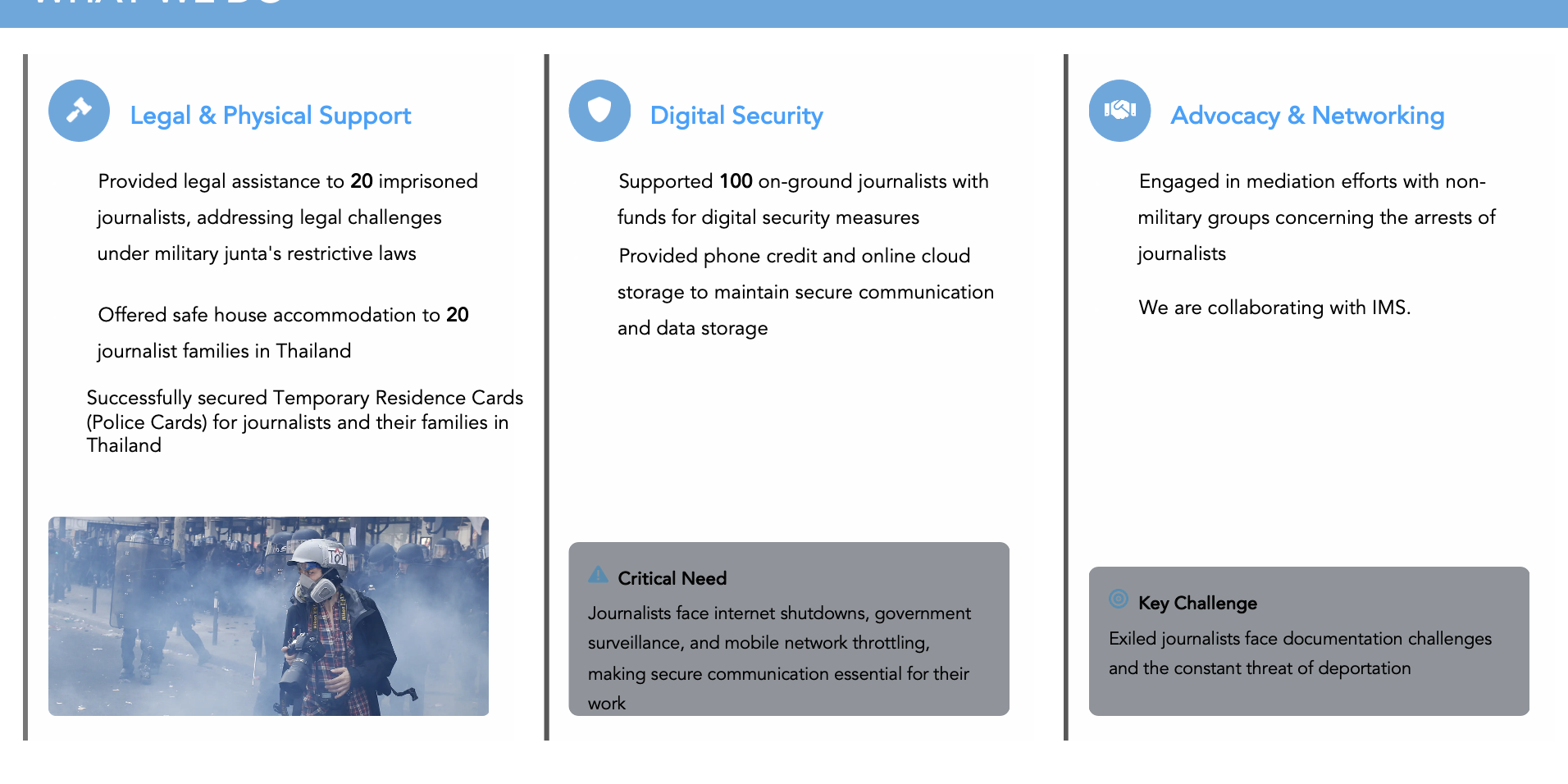
Strengthening journalists’ capacity and providing practical support are essential strategic measures for ensuring the long-term sustainability of independent media. The Independent Myanmar Journalists Association (IMJA) focuses primarily on the following two key areas:
A) Capacity Development
Human Rights Reporting:
Providing training to journalists so they can report on human rights violations effectively and ethically.
Documentation of Human Rights Violations:
Organizing workshops for women parliamentarians to systematically document human rights violations. This initiative is a strategic effort aimed at supporting future justice and accountability processes through proper documentation.
Digital Security:
Providing digital security training and resources to enable journalists to work safely in environments where surveillance is prevalent.
Monitoring and Documentation:
Continuously documenting violations committed against journalists and analyzing evolving conditions and trends.
B) Legal and Physical Support
IMJA has delivered practical support and tangible impact for journalists on the ground through the following initiatives:
Legal Assistance:
Providing legal support for 20 journalists who have been arrested or detained.
Housing Assistance:
Arranging safe houses for 20 journalist families who have fled to Thailand.
Legal Residency Support:
Assisting journalists and their families who have reached neighboring countries to obtain Temporary Residence Cards (Police Cards) in Thailand, helping them avoid immediate deportation.
Digital Security and Communication Support
IMJA has also implemented the following initiatives to support journalists’ digital security and communication needs:
Type of Support Description
Field Journalists Support Financial support provided to 100 journalists working in high-risk environments
Communication Costs Providing phone top-up cards to ensure secure and continuous communication
Data Security Providing cloud storage services to safely store sensitive information
These initiatives serve as critical protective measures for journalists who continue to report daily while facing serious security risks.